Why Caster Choice Matters More Than It Seems
Casters influence the movement of carts, racks, worktables, bins, medical equipment, and mobile storage. A poor match can make a cart difficult to start, noisy to move, or hard to control through narrow aisles. It can also leave marks on finished floors or cause equipment to shift when it should remain stationary.
For example, a loaded cart may roll acceptably on smooth concrete but become difficult to push when it crosses tile transitions, cracked surfaces, expansion joints, or debris. Caster selection is therefore both an equipment maintenance decision and a workplace safety decision.
Start With the Work Environment
Review the actual route before selecting a wheel. The same cart may travel through receiving areas, production zones, elevators, storage rooms, and office corridors, each with different conditions. Choosing suitable 4-inch caster wheels can help support smooth movement across the surfaces and transitions a cart encounters.
- Floor type and condition: Consider concrete, tile, vinyl, wood, carpet, ramps, thresholds, cracks, and floor gaps.
- Exposure: Water, grease, cleaning chemicals, dust, metal shavings, and outdoor dirt can shorten wheel life or interfere with movement.
- Temperature: Cold storage, washdown areas, hot production spaces, and outdoor settings may require materials suited to those conditions.
- Frequency of use: A cart used continuously over several shifts needs more durable components than one moved occasionally.
Match the Caster to the Load
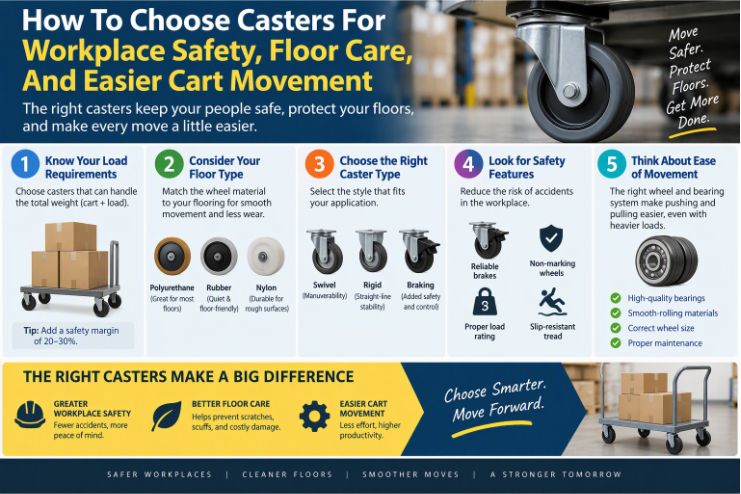
Use the fully loaded weight, not the empty cart weight. Add the cart, equipment, materials, containers, and any expected accessories. Divide that total across the number of load-bearing casters, then leave room for uneven loads and real-world movement.
A four-caster cart does not always distribute weight equally. When it crosses an uneven surface, turns, or carries an off-center load, one wheel may carry more of the weight than the others. Select casters whose rated capacity accommodates those conditions, and stay within the manufacturer’s stated limit.

Choose the Right Wheel Material
No single wheel material is best for every workplace. The practical choice balances capacity, rolling conditions, noise, floor care, temperature, and exposure to contaminants.
- Polyurethane: Often selected for wear resistance, relatively quiet travel, and better floor protection than hard metal wheels.
- Rubber: Can provide useful traction and lower noise where smooth, quiet movement matters.
- Nylon: Can work well on clean, smooth floors, though it may be less forgiving on delicate finishes or rough routes.
- Steel or cast iron: Common choices for demanding loads and harsh industrial settings, but they can be noisy and harder on finished floors.
- Phenolic: Used in some industrial applications where higher loads and heat resistance are important considerations.
Consider Swivel, Rigid, and Locking Designs
Swivel casters help equipment turn in tight spaces, while rigid casters support straight-line movement. A mixed arrangement can give a longer cart better tracking while preserving enough maneuverability for routine steering.
- Directional locks limit swivel action when straighter travel is needed.
- Wheel brakes stop the wheel from rolling but may still allow the caster assembly to swivel.
- Total-lock casters lock both wheel rotation and swivel movement to help keep equipment positioned.
The right arrangement depends on cart length, aisle width, load height, turning requirements, and whether the equipment must stay fixed during use.
Think About Ergonomics and Push Force
Hard-to-roll carts can increase the effort needed to start, steer, and stop a load. Small wheels, worn bearings, flat spots, debris, poor swivel action, and damaged flooring can all add resistance. OSHA’s material-handling guidance emphasizes reducing force and maintaining equipment used to move materials.
- Use larger wheels when carts regularly cross gaps, joints, or uneven surfaces.
- Keep bearings and swivel sections clean and in working condition.
- Balance loads and avoid exceeding the cart’s capacity.
- Use handles that allow workers to push without unnecessary bending or twisting.
- Push rather than pull when the equipment and route allow it.
Reduce Noise, Floor Wear, and Contamination
Wheel hardness, tread condition, embedded debris, and the surface itself affect noise and floor wear. Softer or resilient treads may be preferable where quiet travel and floor protection matter. Inspect wheels for stones, glass, metal fragments, cuts, flat spots, tread separation, and uneven wear.
In kitchens, healthcare settings, laboratories, washdown areas, and outdoor work zones, consider corrosion-resistant components, sealed bearings, and wheel materials compatible with the on-site cleaning products. Designs that are easy to inspect and clean can simplify routine maintenance.
Inspect Casters Before Problems Grow
- Check mounting plates, stems, nuts, and bolts for looseness.
- Spin each wheel and listen for grinding, scraping, or clicking.
- Look for cracks, flat spots, tread loss, and debris buildup.
- Test brakes and locks on a level surface.
- Record recurring failures by cart, location, and shift.
High-use carts may warrant weekly checks, while lightly used equipment may fit a monthly schedule. Repeated failures can indicate a problem with the route, loading, frame, or floor rather than a wheel problem alone.
Use a Simple Selection Checklist
- What is the fully loaded weight?
- What floors, ramps, thresholds, and gaps will the cart cross?
- Will the cart need low noise, strong traction, or floor protection?
- Could water, chemicals, heat, or debris affect the assembly?
- Must the equipment turn tightly, track straight, or remain locked in place?
- Can employees move the loaded cart without excessive force?
Common Mistakes and When to Review the Whole Cart
Common mistakes include choosing by wheel size alone, using a single caster style for every cart, ignoring load height, replacing a damaged caster with a mismatched design, and waiting for failure before inspecting equipment. Review the entire setup if workers report discomfort, loads shift during turns, wheels fail repeatedly, or floors show recurring scratches and impact marks.
Conclusion
The best caster is not simply the largest or highest-capacity option. It is the option that fits the load, route, environment, floor, and people using the equipment. Since pushing and pulling are recognized workplace risk factors, ergonomic work design should remain a consideration in any cart-and-caster decision. Careful selection and regular inspection can improve control, protect floors, and make everyday movement easier.